
0
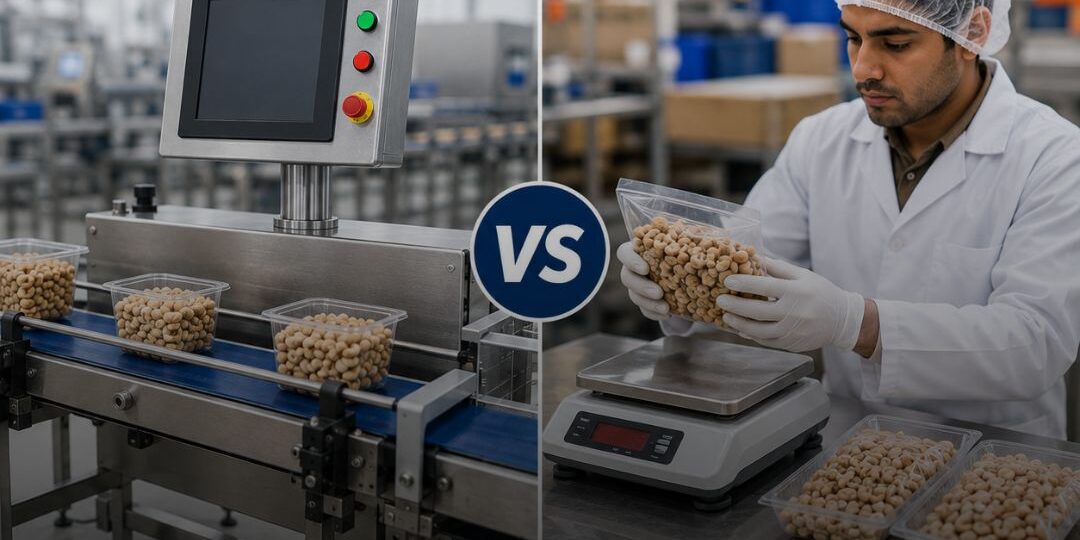
Check Weigher vs Manual Weight Inspection: Which is Better for Production Lines?
In today’s competitive manufacturing environment, accuracy, efficiency, and compliance are critical. Whether you’re operating in food processing, pharmaceuticals, FMCG, logistics, or industrial manufacturing, ensuring that every product meets weight specifications is essential. Many businesses still rely on manual weight inspection, while others have upgraded to an automated Check Weigher system. But which method delivers better results for modern production lines?
In this article, we’ll compare manual weight inspection and automated check weighers to help you determine the best solution for your business.
What is a Check Weigher?
A Check Weigher is an automated weighing system installed directly on a production line. It measures the weight of products while they move along a conveyor and automatically identifies underweight, overweight, or non-compliant products.
Modern check weighers can inspect hundreds of products per minute without interrupting production flow.
Key Functions of a Check Weigher
- Real-time weight verification
- Detection of underfilled or overfilled products
- Automatic rejection of non-compliant items
- Production data collection and reporting
- Quality control automation
What is Manual Weight Inspection?
Manual weight inspection involves employees weighing products individually using platform scales, bench scales, or weighing machines. Operators compare the measured weight with predefined specifications and manually remove products that do not meet requirements. While this method is common in small-scale operations, it presents several limitations in high-volume production environments.
Check Weigher vs Manual Weight Inspection
- Accuracy
- High precision and consistency
- Eliminates human calculation errors
- Maintains accuracy even at high production speeds
Manual Inspection
- Dependent on operator skill
- Greater risk of human error
- Inconsistent results across shifts
- Production Speed
Check Weigher
- Weighs products continuously
- Suitable for high-speed production lines
- No interruption to manufacturing flow
Manual Inspection
- Requires products to be stopped and checked
- Slows production output
- Creates bottlenecks during peak demand
- Labor Costs
Check Weigher
- Requires minimal operator involvement
- Reduces dependency on manual inspection teams
- Lowers long-term labor costs
Manual Inspection
- Requires dedicated personnel
- Increased labor expenses
- Higher training requirements
- Quality Control
Check Weigher
- 100% product inspection
- Immediate detection of weight deviations
- Better compliance with quality standards
Manual Inspection
- Often based on random sampling
- Defective products may go unnoticed
- Greater risk of customer complaints
- Data Collection & Traceability
Check Weigher
Modern check weighers generate production reports including:
- Product weights
- Batch information
- Rejection statistics
- Compliance records
These reports help improve process control and support audits.
Manual Inspection
- Requires manual record keeping
- Time-consuming documentation
- Greater chance of missing data
- Compliance Requirements
Industries such as food, pharmaceuticals, chemicals, and consumer goods often require strict weight compliance.
A Check Weigher helps businesses meet:
- Legal metrology requirements
- Food safety standards
- GMP compliance
- Customer quality specifications
Manual inspection can make maintaining consistent compliance more difficult.
Cost Comparison
Many manufacturers assume manual inspection is cheaper because it requires less initial investment.
However, when considering:
- Labor costs
- Product giveaway
- Rework expenses
- Compliance risks
- Customer returns
An automated Check Weigher often delivers a significantly lower total cost of ownership over time.
When Manual Inspection May Still Work
Manual weight inspection may be suitable for:
- Small production volumes
- Startups with limited budgets
- Low-speed manufacturing operations
- Occasional batch verification
However, as production scales, automated systems become increasingly necessary.
When Should You Invest in a Check Weigher?
Consider upgrading to a Check Weigher if you:
- Process large product volumes
- Experience weight-related quality issues
- Need regulatory compliance
- Want to reduce labor costs
- Require production data and reporting
- Aim to improve operational efficiency
Benefits of Careweigh Check Weighers
At Careweigh, we manufacture advanced Check Weigher systems designed for modern production environments.
Why Choose Careweigh?
- High-speed product inspection
- Accurate weight verification
- Robust industrial construction
- User-friendly interface
- Real-time monitoring and reporting
- Custom solutions for various industries
- Reliable after-sales support
Our check weighers help manufacturers improve productivity, reduce wastage, and maintain consistent product quality.
Conclusion
When comparing a Check Weigher with manual weight inspection, the advantages of automation are clear. Automated check weighers provide greater accuracy, faster inspection, lower labor costs, improved compliance, and better quality control. While manual inspection may work for small operations, growing businesses and high-speed production lines benefit significantly from investing in a reliable Check Weigher solution.
Looking to improve your production efficiency? Contact Careweigh today to find the right check weigher system for your manufacturing process.
Categorycareweigh
