
Call Us: + 91 99222 42189 / 91 89566 59862

Elec Careweigh Pvt. Ltd.

Metal Detector and Checkweigher: Why Production Lines May Need Both

Modern production lines need both these product inspection systems. They also need reliable quality control to ensure that products meet defined weight requirements and are free from unwanted metal contamination. Two important inspection technologies used across food processing, pharmaceutical, packaging, and manufacturing industries are metal detectors and check weighers. Although both systems support product quality and production control, they perform completely different functions. Understanding the difference between a metal detector and checkweigher can help manufacturers determine whether they need one system or both.

What Is a Metal Detector?

An industrial metal detector is an inspection system designed to identify unwanted metallic contaminants that may accidentally enter a product during manufacturing or packaging. Depending on the equipment, product, packaging, and operating conditions, metal detection systems can identify contaminants such as:
  • Ferrous metals
  • Non-ferrous metals
  • Stainless steel
Metal detectors are commonly installed at critical inspection points in a production line to help identify and reject contaminated products before they move further through the process or reach the customer.

What Is a Check weigher?

A check weigher is an automated weighing system that measures the weight of products while they move through a production line. Each product is compared against predefined weight limits. Products that fall outside the acceptable range can then be automatically rejected or separated for further inspection. Check weighers help manufacturers identify:
  • Underweight products
  • Overweight products
  • Missing product components
  • Incorrect pack quantities
  • Weight inconsistencies
They are particularly useful in high-speed production environments where manually weighing every product would be inefficient.

 Metal Detector and Checkweigher: What Is the Main Difference?

The biggest difference between a metal detector and check weigher is what each system inspects. A metal detector looks for metal contamination, while a check weigher verifies product weight.
Feature Metal Detector Checkweigher
Primary purpose Detect metal contamination Verify product weight
Detects underweight products No Yes
Detects overweight products No Yes
Detects metal contaminants Yes No
Automatic rejection Can be integrated Can be integrated
Suitable for conveyor lines Yes Yes
Supports quality control Yes Yes
Common applications Food, pharma, packaging Food, pharma,polymer,abrasive, packaging, manufacturing
Therefore, these systems should not necessarily be viewed as alternatives. They can perform complementary inspection functions within the same production line.
  1. Metal Detectors Help Control Physical Contamination
Metal fragments can potentially enter products through raw materials, damaged processing equipment, machinery wear, maintenance activities, or other stages of production. An industrial metal detector provides an additional inspection stage to help identify metallic contaminants before the product reaches the next stage or leaves the facility. This is particularly important for industries where contamination control and product safety are major quality requirements.
  1. Check weighers Help Maintain Consistent Product Weight
Incorrect product weight can lead to product giveaway, packaging inconsistencies, customer complaints, rework, and unnecessary production costs. A check weigher continuously measures products and identifies packages that fall outside predetermined weight tolerances. For example, if a packaged product should weigh within an established range, the checkweigher can identify units that are either below or above the acceptable limits. This helps manufacturers maintain better weight consistency across large production volumes.
  1. They Inspect Different Quality Parameters
One of the most important considerations when comparing a metal detector vs checkweigher is that neither system performs the other’s primary function. A metal detector cannot determine whether a package contains the correct product weight. Similarly, a standard checkweigher cannot determine whether a product contains a small metal contaminant simply by checking its overall weight. This is why using both systems can provide a more comprehensive inspection process.
  1. Using Both Can Strengthen Production-Line Quality Control
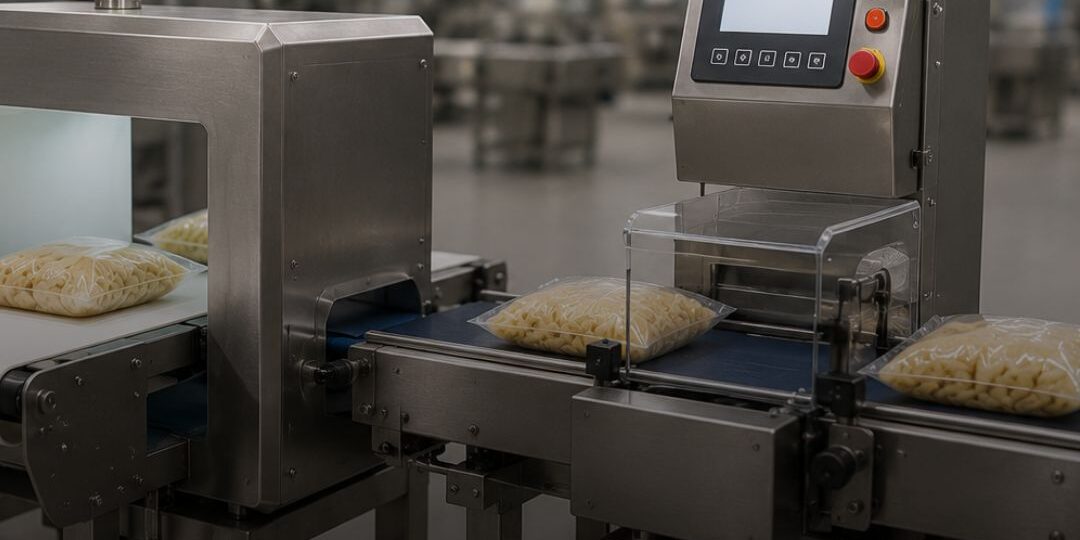
Installing a metal detector and checkweigher on the same production line allows manufacturers to inspect products for two separate quality parameters. The metal detector checks for unwanted metallic contamination. The checkweigher verifies that the product falls within the specified weight range. Together, these systems can help manufacturers improve:
  • Product inspection
  • Weight consistency
  • Contamination control
  • Production efficiency
  • Quality assurance
  • Process monitoring
This combined approach is particularly useful for manufacturers operating high-volume automated production lines.
  1. Automatic Rejection Reduces Manual Inspection
Modern inspection systems can be integrated with automatic rejection mechanisms. When a product fails the metal detection or weight inspection criteria, it can be diverted from the main production line without requiring operators to manually inspect every unit. Depending on the system configuration, rejection mechanisms may include pushers, air blasts, drop mechanisms, or other suitable arrangements. Automation helps manufacturers maintain consistent inspection while reducing dependence on manual checking.
  1. Metal Detectors and Checkweighers Support Food Production The food industry is one of the most common applications for both technologies. A metal detector for the food industry helps manufacturers inspect products for potential metallic contamination. A checkweigher helps ensure packaged food products meet predetermined weight specifications.
These systems can be used across production lines handling products such as:
  • Packaged foods
  • Bakery products
  • Snacks
  • Frozen foods
  • Dairy products
  • Ready-to-eat products
  • Confectionery
  • Processed foods
The exact equipment configuration should be selected according to the product, packaging, line speed, environment, and inspection requirements.
  1. Pharmaceutical Production Can Also Benefit From Both Systems
Product inspection is also important in pharmaceutical manufacturing. Metal detection systems may be used at suitable stages to identify metallic contamination, while checkweighers can verify the weight of packaged pharmaceutical products. Checkweighing may also help identify certain packaging inconsistencies where an incorrect weight indicates a missing or additional component. The appropriate inspection process depends on the product type, packaging format, production requirements, and applicable quality procedures.
  1. Combined Systems Can Save Production-Line Space 
Manufacturers do not always need completely separate inspection stations. Depending on the production requirement, a checkweigher with metal detector can combine weight verification and metal detection within an integrated inspection solution. This can be particularly beneficial where production-line space is limited. An integrated configuration may provide:
  • Weight inspection
  • Metal contamination detection
  • Automated rejection
  • Centralized operation
  • Easier production-line integration
  • More efficient use of floor space
Manufacturers should evaluate line speed, product characteristics, available space, sensitivity requirements, weight accuracy requirements, and integration needs before selecting a system.
  1. Better Inspection Data Can Improve Process Control
Modern automated inspection equipment can provide valuable production information in addition to pass/fail inspection. Depending on the system and configuration, manufacturers may be able to monitor information related to:
  • Product weights
  • Rejection counts
  • Production volumes
  • Inspection results
  • Process trends
This information can help production teams identify recurring issues and make informed process improvements. For example, a pattern of underweight packages may indicate that an upstream filling or dispensing process needs adjustment.
  1. Using Both Systems Can Reduce Quality Risks
Relying on only one type of inspection may leave other quality parameters unchecked. A checkweigher may confirm that the product has the correct overall weight, but that alone does not establish that it is free from metallic contamination. Similarly, a metal detector may confirm that no detectable metal contaminant was identified, but it does not verify whether the package meets its required weight specification. Using both technologies provides two different inspection layers and can strengthen overall production quality control.
